


MEV300 · Moveable rapid charger
300kW for fleets that never stop.
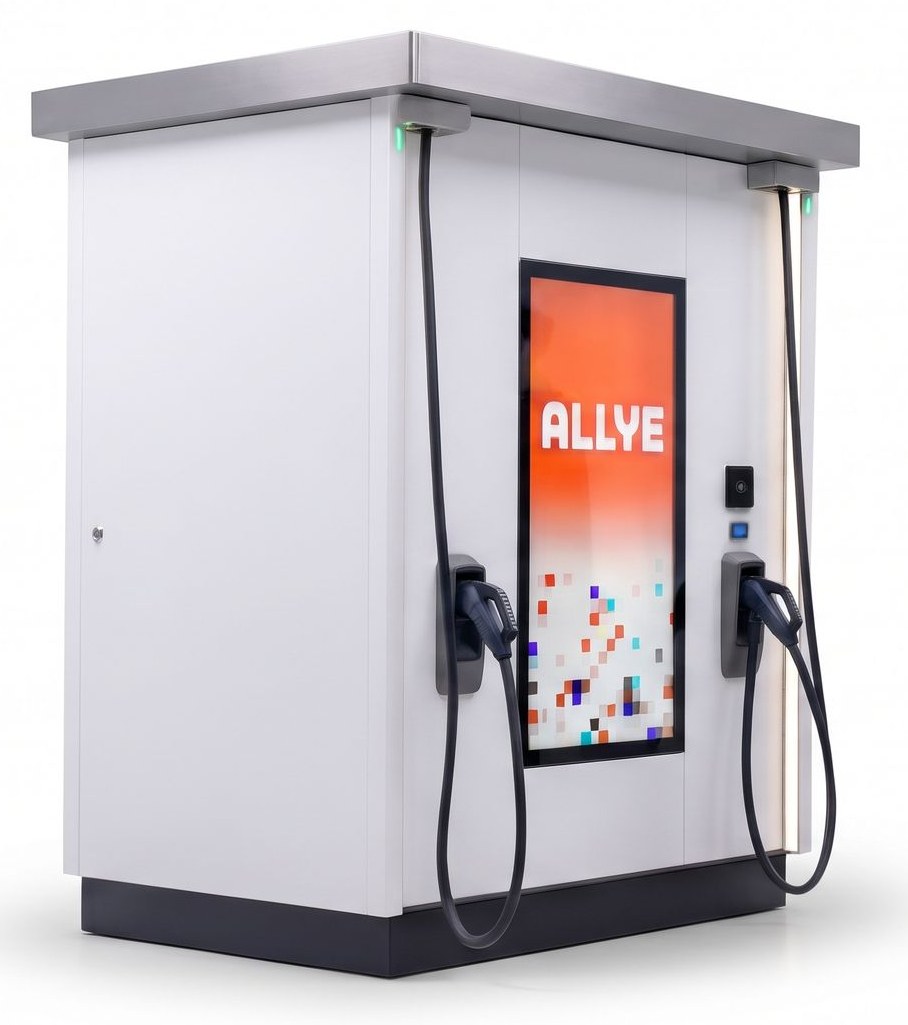
Our most powerful charger, with 232kWh on board for fast turnarounds and bigger batteries. Same cabinet, same small supply.
Why MEV300
More energy for harder-working fleets
- Up to 300kW to a single vehicle
- 50% more battery capacity than the MEV200
- Same cabinet as the MEV200
- Earns from grid services when idle
Best for: Busier depots, larger vans and trucks, and sites with a 63A or larger supply.
Specification
MEV300 technical specification
Specification
| DC charging power | 300kW |
|---|---|
| Maximum to one vehicle | Up to 300kW to an 800V vehicle, about 160kW to a 400V vehicle |
| Charging connectors | Two CCS2, on fold-away arms |
| Battery capacity | 232kWh |
| Architecture | 800V, serving 400V and 800V vehicles |
| Grid supply | 16A to 125A three-phase, at least 32A recommended; single-phase option |
| Throughput | 8 to 10 vehicles a day on a 63A supply over eight hours, at 55 to 70kWh each |
| Payment and access | Contactless card terminal, RFID, help button |
| Connectivity | OCPP 1.6J and 2.0.1, ISO 15118 Plug and Charge, MID-certified metering |
| Lighting and cameras | Lights on approach, with security cameras |
| Accessibility | Designed to PAS 1899 |
All specifications are subject to change without notice.
Installation, lifetime cost and ways to buy.
FAQ
Questions buyers ask
What supply does MEV need?
MEV runs on a three-phase supply from 16A to 125A as standard, with a single-phase option for sites where daily energy use is low. The supply sets how quickly MEV recharges, so we recommend at least 32A three-phase for a full overnight recharge.
How many vehicles can one MEV charge in a day?
On a 63A supply over an eight-hour day, one MEV is designed to serve 7 to 10 vehicles at 55 to 70kWh each. Over a day, the supply sets throughput; the battery sets how fast each vehicle charges.
Does MEV need planning permission?
MEV is designed to fit within permitted development at depots and car parks in England, subject to site checks. Rules differ in Wales, close to homes and on the street. We check your site before you order and help with any application, but we can't promise the outcome.
Should I choose MEV or MAX?
If the charger stays put at your depot and only ever charges vehicles, choose MEV. If the energy needs to move, power a site, feed a row of separate chargers or be towed on a standard car licence, choose MAX. Many fleets will use both.
Can I move MEV if my depot moves?
Yes. MEV is fixed in use, bolted to a flush plinth, but it can be unbolted and lifted out by forklift or crane and re-sited, with minimal cost.
Talk to us about the MEV300.
Tell us your supply, your vehicles and how long they stand at base. We'll size the MEV, check the siting and price it outright or as a monthly service.
- Your supply size, or a photo of your main fuse board
- Vehicle numbers, battery sizes and dwell times
- A site plan or address so we can check siting
sales@allye.com+44 (0)20 805 06560